PENFIELD
SPIKEBALL

Official PSL Spikeball Rules
Basic Game Rulebook
1.0 The Game
1.1 Spikeball is a competitive game played by two teams of two players on a field with a net in the center, in accordance with these rules, under the jurisdiction of a referee.
1.2 The objective of the game is to score more points than the opposing team.
1.3 A point is awarded by winning a rally.
1.4 The winner of the game is the team that scored the greatest number of points upon the conclusion of the game.
1.5 The game ends when one team scores 11 points and has scored at least two more points than the opponent.
1.6 If a team scores 11 points but has not scored at least two more points than the opponent, the game will continue until either team scores 11 points with a lead of at least two or either team reaches a score of 16.
1.7 If a team reaches a score of 16 points, the game is concluded, and they shall be declared the winner.
Full Rulebook
The Field of Play and Equipment:
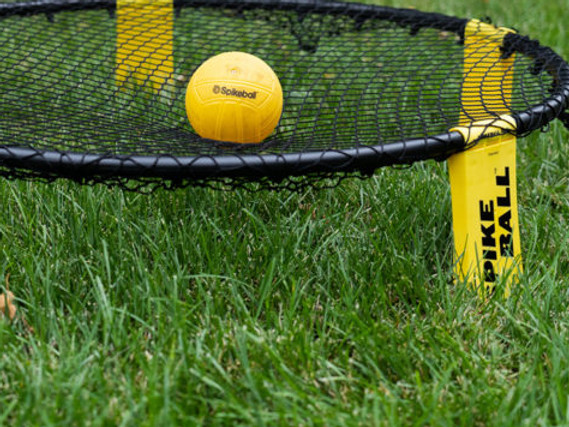
All games shall be played with an official Spikeball net and official Spikeball game balls.
The net and game balls must be in playable condition at the discretion of the referee.
All games shall be played on a flat surface with no hazards that could compromise safety or impact gameplay.
The field of play shall have a 30-foot radius from the center of the net that is completely clear of any obstruction that could compromise safety or impact gameplay.
The field of play must be in accordance with league regulations at the discretion of the referee prior to the begging of the game.
The only individuals permitted on the field of play are the four players and league officials. Spectators must remain outside of the field of play and can be dismissed by the referee at any time.
Referees and League Representatives:
All Penfield Spikeball League games must be observed by at least one league representative, preferably a referee. If no referee is present, a league representative shall serve as the acting referee.
The referee is a league-appointed official responsible for upholding the rules of the game and arbitrating disputes between players.
The referee has final authority over any ruling. All rulings made by the referee cannot be challenged.
If more than one official is assigned to a game, one official shall be designated as the referee and execute the duties of the referee, while the other official(s) are designated as assistant referees and have the responsibility of providing assistance to the referee on rulings.
The Serve:
Each rally shall start with a serve.
Prior to each serve, all players must be positioned 90° apart around the net. Teammates must be positioned adjacent to each other.
The positioning of the players shall be determined prior to the game and shall remain constant on all serves throughout the game.
Serves shall be made by holding the ball in one hand, tossing it upward, and striking it overhand with one hand legally onto the net.
The serving player must be stationary and must wait until all other players are correctly positioned before serving.
Penfield Spikeball League abides by a “gentleman serve rule”. All serves must be made with low intensity and must be playable with low difficulty. Serves cannot be made with any intention to score or gain an advantage.
Within reasonable boundaries, the receiving team can request a replay of the serve if they do not believe it conformed with the “gentleman serve” conditions.
Serves must be made to the opponent directly across from the serving player.
If the serving player makes an illegal serve, the serve is replayed. If on the second attempt the serving player fails to make a legal serve, the point is awarded to the opponent. Gentleman serve violations do not count as illegal serves.
In tournament play, the higher seed team shall choose whether to serve or receive the ball at the beginning of the game. In league play, the option shall be given to the winner of a coin toss.
On a team’s first serve of the game, the player on the right shall serve the ball.
On all serves after the first serve, the possession of the serve is given to the team that won the previous rally.
The serve alternates between both players on each serve possession. If a team wins consecutive rallies, the same player serves.
If a serve is made by the wrong player, any action after that serve is nullified and the served is replayed.
Playing the Ball:
The ball is in play the moment the serve strikes the net.
Teams are allowed up to three contacts to return the ball to the net.
A player cannot contact the ball two times consecutively.
A player cannot carry, catch, establish control, or make contact extended beyond a quick, instantaneous hit.
Serves cannot be directly returned. Both players must touch the ball at least once before a serve can be legally returned. All other hits may be directly returned.
In a legal hit, the ball must be struck with any part of the player’s hand.
Players cannot contact the ball with both hands simultaneously.
Players cannot deliberately contact the ball with any part of their body other than their hands (kicking, heading, etc.).
A player may non-deliberately contact the ball with any part of their body other than their hands. Non-deliberate contacts not with body parts other than hands do not count towards the three allowed contacts.
Scoring:
One point is awarded each time a team wins a rally.
A team wins a rally if any of the following occurs:
The opponent fails to legally return a serve or hit.
The opponent commits two consecutive service faults.
The opponent commits any game infraction listed in the fouls and infractions section of this rulebook.
Fouls and Infractions:
Game Infractions
A team loses the rally, and one point and possession of the serve is awarded to the opponent upon the commission of any of the following game infractions:
A hit contacts the net's rim (pocket hits are legal).
A player contacts any part of the net during gameplay.
The ball contacts the net more than once.
A player carries, catches, establishes control, or makes a contact extended beyond a quick, instantaneous contact.
A player contacts the ball out of order.
A player illegally contacts the ball.
Interference:
Interference is defined as any time a player hinders or impedes the opponent's progress toward the ball or ability to contact, pass, or hit the ball. Interference can be with or without contact.
Interference can only be called if the referee believes the player would have been able to successfully play the ball had the conflict not occurred.
When interference is called the ball becomes dead. If no interference is called, even if one team believes that have been interfered with, the ball is still live.
The rally shall be replayed if the following conditions are met:
The referee determines the conflict meets the conditions of interference.
The opposing player in question made an effort to evade interfering with the play.
The conflict was unintentional.